
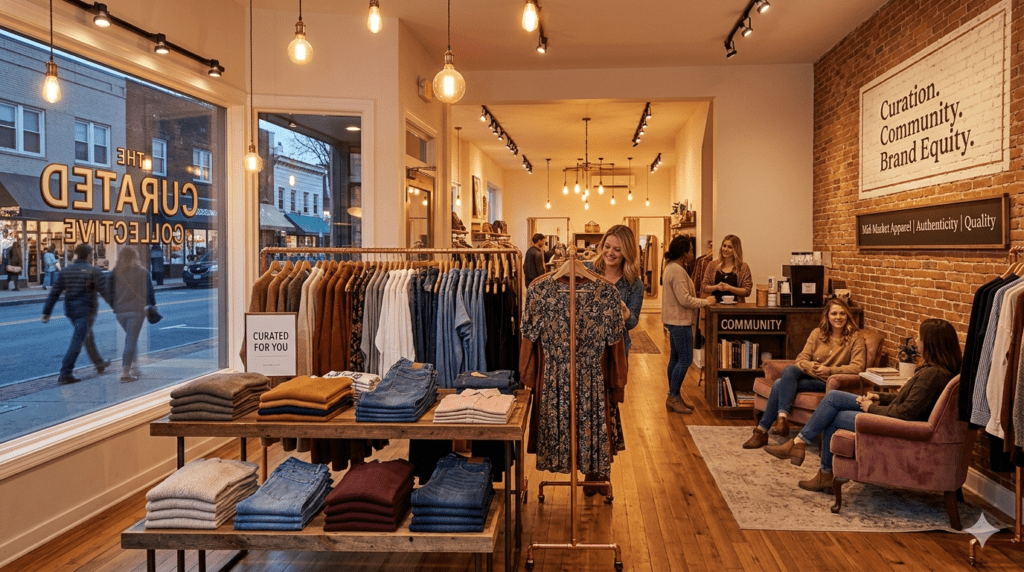
For over a decade, one narrative has dominated retail: Amazon won, and everyone else must adapt or perish. This has pushed countless mid-market apparel retailers to chase Amazon’s playbook — racing to offer faster shipping, bloating SKU counts, and competing on price above all else. But this strategy is not just difficult to execute — it is fundamentally misguided. Mid-market apparel retailers cannot beat Amazon at its own game, and they should stop trying. The brands that will thrive in the next decade are those that recognize where Amazon is weak and build their strategies around those gaps.
Different Business Models Require Different Strategies
Amazon is, at its core, a technology company that happens to sell products. Its competitive advantages — logistics infrastructure, proprietary data systems, and marketplace network effects — were built over decades and required billions in capital investment. No mid-market apparel retailer can replicate that infrastructure, nor should they attempt to.
Amazon’s model is built around being everything to everyone, a strategy that only becomes profitable at massive scale. Mid-market retailers, by contrast, thrive by being something specific to someone particular. When a regional clothing brand tries to compete on Amazon’s terms, it abandons its actual strengths: curated selection, brand identity, community connection, and specialized expertise. Those are the assets worth investing in.
For a deeper look at how Amazon has reshaped the logistics landscape, see Conveyco’s apparel industry solutions for context on what right-sized fulfillment looks like for brands at this scale.
The Race to the Bottom on Price Destroys Apparel Brand Value
Amazon has conditioned consumers to expect rock-bottom prices and perpetual discounts. That model works for a marketplace selling commoditized products at razor-thin margins made up by volume. For apparel brands trying to build lasting value, it is poison.
Mid-market retailers that compete primarily on price enter a cycle they cannot escape. They train customers to wait for sales, erode their margins, and systematically destroy the perceived value of their merchandise. Unlike Amazon, which can absorb retail losses across its broader business, apparel-focused brands have no safety net to fall back on.
Worse, price-driven positioning attracts the most disloyal customers. The moment a competitor offers a better deal, those shoppers are gone. This is the opposite of building a sustainable retail business.
Curation Is a Competitive Advantage Mid-Market Apparel Retailers Can Own
Amazon’s catalog runs into the hundreds of millions of items. For many shoppers, that breadth creates paralysis rather than convenience. Mid-market apparel retailers have a real opportunity to win through expert curation instead of exhaustive selection.
Today’s consumers — especially in apparel — are overwhelmed by choice. They are looking for retailers who can edit the options, provide taste-making guidance, and help them navigate an oversaturated market. A carefully curated collection of 500 items, chosen by people who genuinely understand a specific customer, will consistently outperform an algorithm-sorted warehouse of 50,000 options for the right audience.
The apparel retailers succeeding right now are not trying to carry everything. They carry the right things for their specific customer, and that focus is their strength, not their limitation.
Experience and Community Cannot Be Shipped in Two Days
Amazon optimizes for transactional efficiency: click, buy, receive. That model works well for replenishing household staples. It fails to capture what makes apparel shopping meaningful for many consumers.
Mid-market retailers can create experiences Amazon simply cannot replicate — in-store styling sessions, community events, personalized service from knowledgeable staff, fitting expertise, and the social dimension of shopping with friends. These are not weaknesses of physical retail. They are its greatest strengths.
Even in digital channels, mid-market retailers can build communities through content, style inspiration, and direct customer relationships that feel personal rather than algorithmic. Amazon’s scale prevents this kind of intimacy. Mid-market retailers should lean into it deliberately.
Sustainability and Ethics as Apparel Retail Differentiators
Amazon’s model prioritizes speed and low cost above almost everything else — often at the expense of sustainability, ethical production, and supply chain transparency. This creates a genuine opening for mid-market apparel retailers to compete on values.
Consumers, particularly younger generations, increasingly want to know where their clothing comes from, who made it, and what environmental impact their purchase carries. Mid-market retailers can tell these stories authentically because they work with smaller, more knowable supplier networks and can actually verify what they claim.
A brand that credibly communicates its commitment to sustainable materials, fair labor practices, and environmental responsibility can command premium pricing and genuine customer loyalty that no amount of free two-day shipping can touch.
The Local Advantage in a Homogenized Retail World
As Amazon and large fast-fashion chains homogenize the retail experience across the country, there is growing consumer demand for products and experiences that feel locally meaningful. Mid-market retailers often have deep community roots and can leverage local identity in ways that massive national platforms never can.
Whether it is carrying local designers, hosting community events, supporting regional causes, or simply understanding the specific climate and lifestyle of their geography, local relevance is a competitive moat that Amazon will never cross.
Data Intimacy vs. Data Scale
Amazon possesses more customer data than almost any company on earth. But mid-market retailers can have something more valuable in practice: intimate, personal knowledge of individual customers and the ability to act on it directly.
When a boutique owner remembers that a regular customer’s daughter is getting married this spring, or a sales associate texts a loyal shopper about a new arrival that matches their style, that is relationship commerce that no recommendation algorithm can replicate. This kind of high-touch service creates customer lifetime value that price competition cannot come close to delivering.
Building Brand Equity Instead of Becoming a Distribution Channel
The most important distinction is this: Amazon is primarily a distribution channel. Customers do not feel emotional connection to it the way they do to brands they love. Mid-market apparel retailers have the opportunity — and the obligation — to build genuine brand equity.
Brand equity is built through a consistent aesthetic point of view, values alignment, community building, and emotional connection over time. These intangible assets allow retailers to maintain pricing power, weather economic downturns, and earn customer loyalty that outlasts any transactional convenience. That is the foundation worth building.
Smart Fulfillment Operations Do Not Require Amazon-Scale Investment
Mid-market apparel retailers do not need Amazon’s infrastructure budget to run accurate, reliable fulfillment operations. Modern warehouse execution systems and targeted automation solutions allow smaller operations to achieve high accuracy rates and strong throughput at a fraction of what enterprise-scale implementations require.
The key is selecting technologies that match your actual volume and complexity — not trying to build what Amazon built. Automated picking systems that reduce errors, conveyor solutions that improve throughput, and intelligent software that orchestrates fulfillment processes can all support your brand promises without forcing you to think like a logistics company first and a retailer second.
Conveyco works with mid-market operations to design right-sized fulfillment solutions that support apparel brands without over-engineering. Learn more about warehouse automation technologies built for operations like yours, or explore how front-end automation reduces costly returns by getting orders right the first time.
The Path Forward: Play Your Own Game
The most successful mid-market apparel retailers over the next decade will not be the ones who best copy Amazon. They will be the ones who most clearly understand what Amazon cannot do — and invest deliberately in those advantages.
That means accepting that you will not be the cheapest or the fastest. It means cultivating a specific point of view rather than trying to appeal to everyone. It means investing in relationships and experiences rather than purely in logistics and price optimization. It means building operational excellence in the dimensions that actually matter to your customers — accuracy, fit, curation, and service — rather than competing on speed alone.
Amazon has already won the game of being Amazon. The opportunity for mid-market apparel retailers is not to play that game but to build an entirely different one where their natural advantages can compound. The retailers who understand this will not just survive in Amazon’s shadow. They will build businesses that Amazon can never replicate.
Frequently Asked Questions
Why can’t mid-market apparel retailers compete with Amazon on price and shipping speed?
Amazon’s pricing and fulfillment capabilities are supported by decades of infrastructure investment and revenue from non-retail business units that allow it to absorb retail losses. Mid-market apparel retailers do not have those financial buffers. Competing on Amazon’s terms means entering a race where the rules and resources are fundamentally stacked against smaller brands, ultimately eroding margins and brand value without a path to sustainable advantage.
What are the strongest competitive advantages for mid-market apparel retailers?
Mid-market apparel retailers are best positioned to win through expert product curation, community and relationship building, in-store and online experiences that feel personal, authentic storytelling around sustainability and ethics, local relevance, and high-touch customer service. These are areas where scale is not an advantage — and where Amazon’s size is actually a liability.
How does curation help apparel retailers stand out from Amazon?
Where Amazon offers hundreds of millions of items, a thoughtfully curated collection built around a specific customer creates clarity and confidence rather than overwhelm. Consumers increasingly want retailers who act as trusted editors — helping them find the right products rather than presenting every possible option. Curation transforms the shopping experience from a search task into a guided recommendation, which drives loyalty and conversion.
Can mid-market apparel retailers run efficient fulfillment without massive investment?
Yes. Modern warehouse execution systems and targeted automation solutions allow mid-market operations to achieve high order accuracy and efficient throughput without enterprise-scale budgets. The most effective approach is selecting technologies scaled to your actual volume and operational complexity — not attempting to replicate Amazon’s infrastructure. Right-sized automation supports your brand promises without requiring you to prioritize logistics over retail strategy.
How can sustainability become a competitive differentiator in apparel retail?
Consumers, especially younger shoppers, increasingly factor environmental and ethical considerations into their purchasing decisions. Mid-market apparel retailers that work with smaller, more transparent supplier networks are in a credible position to tell authentic stories about where their products come from and how they are made. This authenticity can command premium pricing and build the kind of customer loyalty that price-driven competitors cannot replicate.
What role does brand equity play in long-term apparel retail success?
Brand equity — the emotional connection and trust a retailer builds with its customers over time — is one of the most durable competitive assets in retail. It allows brands to maintain pricing power, attract loyal customers who return without being incentivized by discounts, and weather economic downturns that erode purely transactional retailers. Unlike distribution efficiency, brand equity cannot be purchased or scaled quickly by a competitor, making it one of the few genuine moats available to mid-market apparel retailers.
