
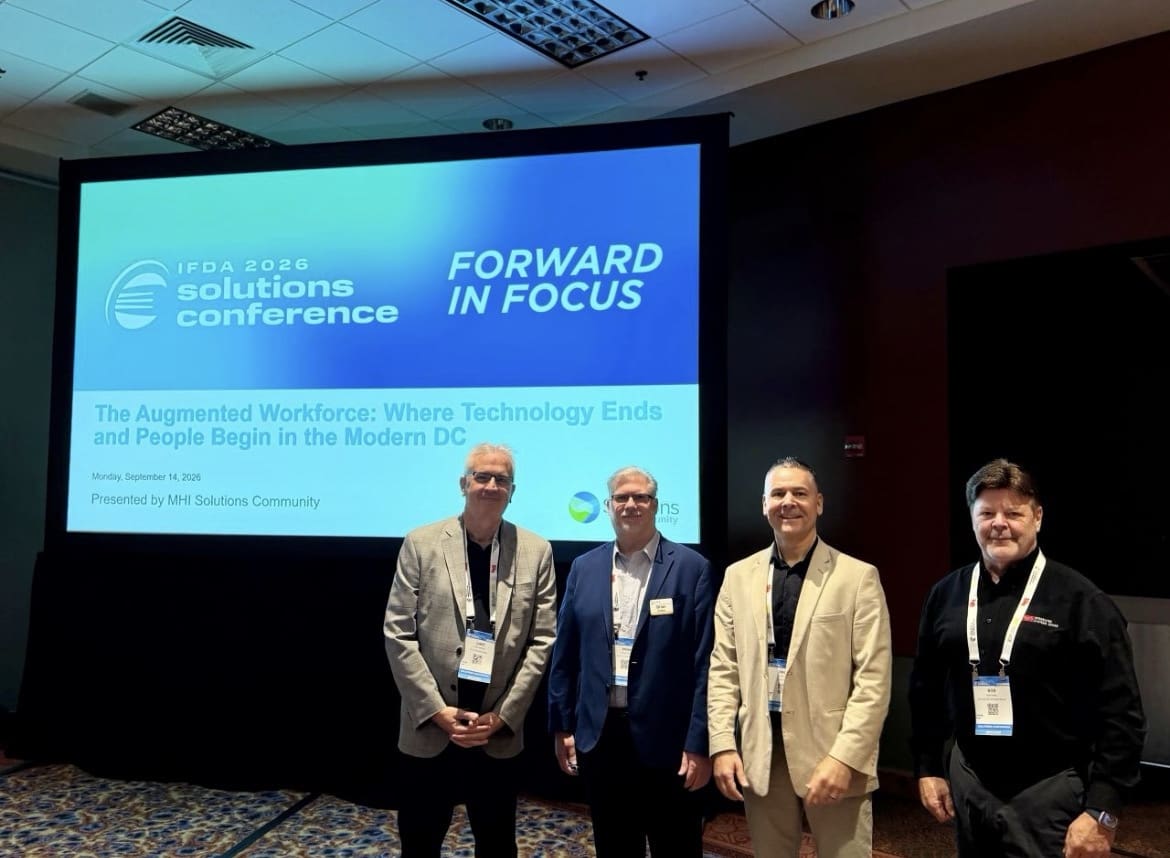
I recently spoke at an IFDA seminar session as part of MHI’s Solutions Community, and the conversation that followed has stuck with me since. It got me thinking about something we talk about constantly in warehouse automation but rarely frame the right way.
Most people walk into an automation project asking what they can automate. I’d argue that’s the wrong starting point. The better question, the one that actually shapes a good outcome, is what you should automate. Those two questions sound similar, but they lead to very different projects.
The more I sat with the discussion afterward, the more I kept coming back to one idea. The future of the distribution center has less to do with people versus technology and more to do with figuring out where each one actually earns its place on the floor. People, software, robotics, and automation working together is what I mean when I talk about an augmented workforce, and that’s a far more interesting conversation than counting how many people a piece of equipment can replace.
Automation Doesn’t Have to Mean Fewer People
There’s a tendency to build the entire business case for warehouse automation around labor savings. Labor is real, and anyone running a distribution center today knows how hard it can be to find and keep people, especially when volume spikes or the work is repetitive and physically demanding. But labor savings are not the only reason to automate, and treating them as the only reason sells the whole idea short.
Sometimes the more useful question is how you help the same team do more. Take a goods-to-person operation as an example. Instead of an employee walking thousands of feet a day hunting for product, the automation brings the product to them. That person is still picking the order and still doing meaningful work. The difference is they’re spending their shift picking instead of walking around looking for something to pick. It’s a simple example, but it gets at the larger point: technology is good at repetitive, predictable work, and people are good at judgment, problem solving, and handling situations nobody planned for. The opportunity is putting those two strengths next to each other instead of pitting them against one another.
People Are Still Better at the Things Nobody Planned For
Anyone who has spent real time in a distribution center knows the operation rarely behaves the way it looked on the flow diagram. A carton shows up with a damaged label. The packaging changed without anyone updating the system. The quantity doesn’t match what’s expected. A product isn’t where it’s supposed to be. An order just doesn’t make sense. Something happens that nobody anticipated when the system was designed, and that’s not a flaw in the plan, it’s just reality.
The automation can usually flag that something is wrong. Figuring out what to do about it still tends to fall on a person, and that’s a sign of good design rather than a gap in it. When we build an automated system, exceptions need to be part of the conversation from day one, not something we figure out after go-live. Where are exceptions likely to happen? What can the software actually handle on its own? Where does a person need to step in, and how fast do they need to respond? And maybe most importantly, what happens to the rest of the operation while that one exception gets resolved?
Eliminating every exception was never realistic. The goal is keeping one from turning into a problem for everything around it: an exception station, a manual work area, a bypass lane, a human-in-the-loop decision point, software that routes the issue to the right person. Really, it’s a workflow coordination problem as much as an equipment one. We’ve written more on how workflows get orchestrated across a distribution center if you want to go deeper on where those bottlenecks tend to hide.
The Warehouse Worker Is Changing
As repetitive work gets automated, the role of the warehouse associate changes with it, and that’s not necessarily a bad thing. Someone who used to spend an entire shift walking, lifting, or moving product might instead spend their day operating equipment, monitoring a process, resolving exceptions, or working directly with warehouse technology. The skill set required in an automated distribution center can look genuinely different from a traditional one.
Employees increasingly interact with scanners, WMS and WES software, robotics, automated storage and retrieval systems, and sortation equipment. New roles open up too, in fleet management, automation support, controls, maintenance, and data. Automation can change jobs without simply eliminating them, but that only holds true if companies are honest with their people about what’s actually changing.
You Can’t Automate Your Way Around Change Management
This is one of the areas I think gets overlooked most often. People have questions when new technology is coming into their building. What does this mean for my job? How is my day going to change? What happens if the technology doesn’t work the way it’s supposed to? Am I going to have to learn something completely new? None of those are unreasonable questions. They’re exactly what I’d expect someone to ask if I were in their position.
One of the worst things a company can do is pretend nothing is going to change, because something will. The better approach is explaining what’s changing, why it’s changing, and where employees fit into the operation once the dust settles.
Maybe the person who used to spend a shift moving product becomes an automation operator. Maybe they step into a team lead role. Maybe they take on exceptions, maintenance, or another part of the operation entirely. None of that promises every job stays the same. What it gives people is a real reason to believe they have a future in the building.
There’s a line from that discussion that stuck with me more than anything else: “You have to bring the people along with the technology.”
The People Using the System Should Help Design It
Here’s a lesson that keeps getting reinforced project after project: the people doing the work every day know things the project team doesn’t. You can have an airtight requirements document and still miss something an experienced warehouse associate notices without even thinking about it. That’s why the workforce needs to be involved early, not consulted after the fact.
Ask the people on the floor where the process breaks down, what slows them down, what causes the most frustration, where mistakes tend to happen, and what they’d change if they had the authority to do it. Then keep listening after the system goes live, because a warehouse automation project doesn’t actually end when the equipment gets turned on. The operation keeps teaching you things long after launch. If something isn’t working, fix it. If something is working better than expected, figure out why. If the people running the system have an idea worth trying, listen to it. You don’t build trust by telling employees automation won’t affect them, because it will. You build trust by giving them an actual role in shaping what the operation becomes.
The ROI of Warehouse Automation Is Bigger Than Labor Savings
Labor savings still matter, but they’re only one slice of the business case. When I think about ROI on an automation project, I want to know a lot more than how many labor hours a system eliminates. Can the operation process more orders with the same footprint? Can the current workforce absorb peak season without a hiring scramble? Is inventory and order accuracy actually improving? Are cycle times coming down? Is the equipment being used well, or sitting idle half the shift? Are employees spending more of their time on work that actually moves the business forward? Are safety incidents dropping? Can the operation flex when volume changes without a scramble?
That last question matters more every year. Picture a distribution center that can process 30 percent more volume during peak season without hiring 30 percent more people. The company may not have eliminated a single position, and that can still be one of the most successful automation projects on the books. The real value often comes from capacity, consistency, flexibility, and resilience, not just a smaller headcount line.
Sometimes the Right Answer Is Less Automation
This might be the point I wish showed up in more conversations about automation. Not everything should be automated. There are processes where automation makes obvious, easy sense, and there are others where the variability, the product characteristics, or the sheer number of exceptions make automation more trouble than it’s worth. I’ve seen enough of these projects to know the most automated solution isn’t automatically the best one.
In fact, it’s entirely possible to spend a tremendous amount of money trying to automate the last 10 percent of a process, only to discover that last 10 percent accounts for 90 percent of your exceptions. The smarter answer is usually automating the predictable 80 to 90 percent and giving people a well-designed way to handle what’s left. Good system design, not a compromise.
The same principle holds before a project even breaks ground. If inventory accuracy is poor, processes aren’t standardized, the WMS isn’t ready, or the operation is already drowning in exceptions, adding automation on top of that mess just automates a bad process faster. Automation can’t fix every operational problem on its own. Sometimes the right first step is fixing the process, not buying the equipment.
Start With the Work
If you’re thinking about warehouse automation, I’d start somewhere other than a list of robots and vendor names. Start with the work itself. Where are people spending most of their time? Where are they walking that they shouldn’t have to? Where are they standing around waiting? Where is the work repetitive in a way that wears people down? Where do errors keep showing up? Where does the operation struggle when volume spikes during peak?
Once you actually understand those things, you can start asking where technology genuinely makes the operation better, rather than where it just looks impressive on a walkthrough. You don’t have to automate everything at once, either. Often the smartest move is starting with one process, proving the model works, learning from what didn’t go as planned, and expanding from there. That’s the thinking behind our own RightFIT methodology, a step-by-step approach that starts with a deep look at the work itself before anyone talks about equipment.
The Future of Warehouse Automation Is Adaptability
Coming out of that seminar, the word that kept coming back to me was adaptability. The distribution centers that come out ahead won’t necessarily be the ones with the most robots or the highest degree of automation on the floor. They’ll be the ones that can adapt when conditions shift, and conditions always shift. Volumes change. Labor markets change. Customer expectations change. Products change. The technology itself keeps changing. The warehouse has to change right along with all of it, which means people, automation, software, data, and AI need to work together as one operating model rather than as competing initiatives.
Which brings me back to where I started. The answer to what you should automate isn’t going to be the same for every distribution center, and honestly, that’s the whole point. The best strategy finds the right combination of people and technology for the operation you’re actually running, not the one on a slide deck.
People with technology, not people versus it.
Frequently Asked Questions About Warehouse Automation and the Augmented Workforce
What is an augmented workforce in a warehouse?
An augmented workforce combines people, warehouse automation, software, and robotics so that each one focuses on the work it does best. The goal isn’t always to reduce headcount. It can just as easily mean higher throughput, better productivity, less physical strain on workers, and more overall capacity and flexibility in the operation.
Does warehouse automation replace warehouse workers?
Not necessarily. Automation can reduce the labor needed for certain repetitive tasks, but people remain essential for exception handling, decision-making, troubleshooting, and the parts of the process that are difficult or uneconomical to automate.
What should companies consider before automating a warehouse?
Companies should first understand their processes, labor requirements, throughput, variability, inventory accuracy, and where exceptions tend to occur. The right automation strategy depends entirely on the specific operation, and automating a process that isn’t already well designed tends to make existing problems worse, not better.
Why are exceptions important in warehouse automation?
Exceptions are unavoidable in nearly every distribution center. Products get damaged, labels are wrong, quantities don’t match, and unexpected situations pop up constantly. Effective warehouse automation plans for these exceptions upfront and gives people or software a clear path to resolve them without disrupting the rest of the operation.
How should companies measure warehouse automation ROI?
ROI should account for labor productivity, throughput, order accuracy, inventory accuracy, cycle time, equipment utilization, safety, employee retention, peak-season capacity, and overall operational flexibility. Labor savings are just one measure of the total value an automation project delivers.
What is the role of people in an automated warehouse?
People stay responsible for the work that requires judgment, problem solving, exception handling, and real operational decision-making. As automation expands, warehouse employees also take on new roles in automation operation, software, robotics, fleet management, maintenance, controls, and data.
About Brian Keiger
Brian Keiger is Chief Brand Officer at Conveyco Technologies, a privately held, family-owned, U.S.-operated warehouse automation systems integrator. He works with organizations evaluating warehouse automation and developing practical strategies for improving distribution center operations.
If you’re weighing what to automate in your own operation, Conveyco’s team starts every conversation the same way this article does, with the work itself, not a product list. You can schedule a free consultation to talk through where your operation actually stands.
