
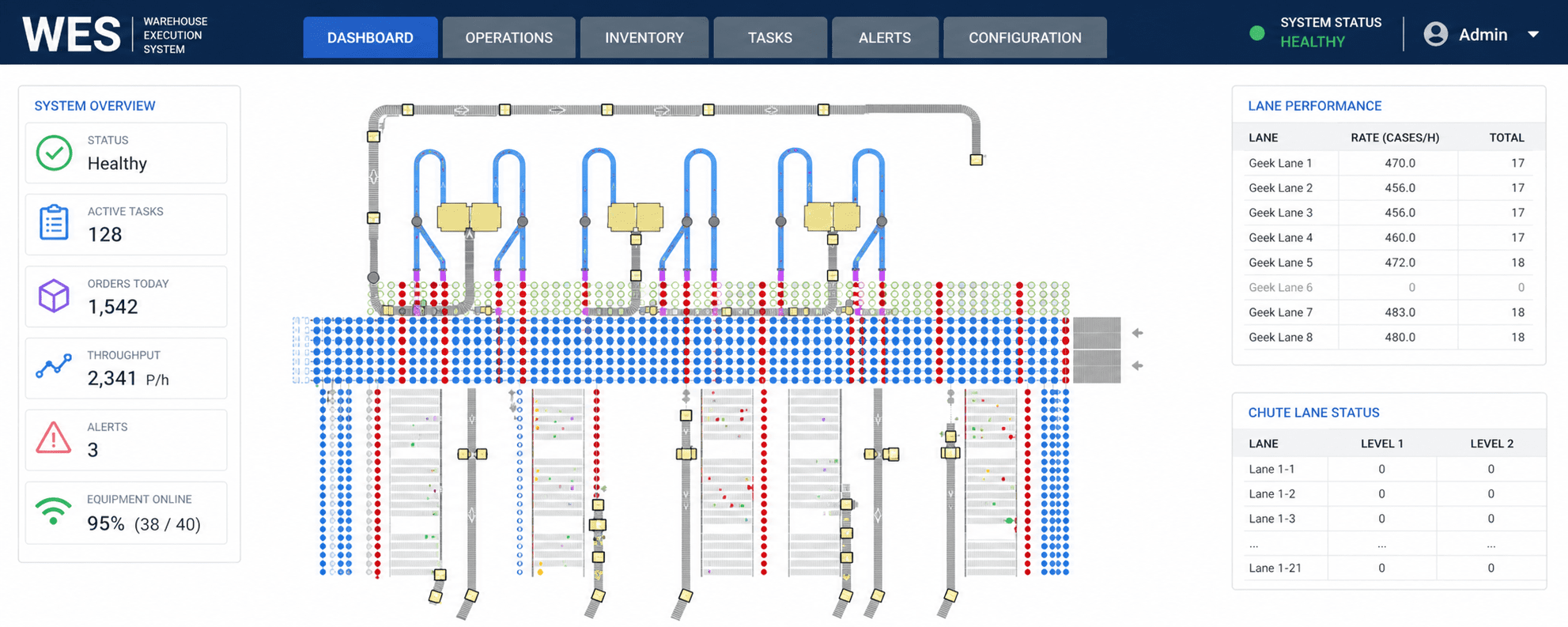
WAREHOUSE EXECUTION SYSTEMS | ECOMMERCE DISTRIBUTION | WAREHOUSE AUTOMATION
Ecommerce distribution centers are getting more complex. Warehouse execution systems give operations teams a way to coordinate WMS, automation, inventory, labor, order fulfillment, and shipping in real time.
For years, the Warehouse Management System (WMS) has been the center of the warehouse technology stack. And it should be. A WMS is responsible for managing orders, inventory, and the broader warehouse operation.
But modern ecommerce distribution centers are asking their WMS to do more than it was designed to do.
They are asking it to coordinate AS/RS, shuttles, conveyors, sortation, robotics, AMRs, picking systems, labor, inventory movement, carrier requirements, and increasingly complicated order profiles, all while responding to what is happening on the warehouse floor right now.
That is where a Warehouse Execution System (WES) comes in.
At Conveyco, we built New Dawn Warehouse Execution Software to connect the systems inside the four walls of a distribution center and coordinate the work happening between them.
What Is a Warehouse Execution System?
A Warehouse Execution System (WES) is software that manages and optimizes the work happening inside a distribution center in real time.
A WES connects the WMS, automation, equipment, inventory, and people so the operation can determine what work needs to happen next, prioritize that work, and coordinate how it gets done.
In simple terms:
- WMS: Manages orders, inventory, and the broader warehouse operation.
- WCS: Controls individual pieces or zones of automated equipment.
- WES: Coordinates the work between the WMS, automation, equipment, and people.
This distinction becomes increasingly important as distribution centers become more automated.
A WMS can tell you what orders need to be fulfilled. A WES helps determine how those orders should be executed across the warehouse in real time.
That is the role of warehouse execution software.
WES vs. WMS: What Is the Difference?
The simplest way to understand the difference between a WES and a WMS is this:
A WMS manages the warehouse. A WES manages the execution of the work happening inside it.
A WMS is typically responsible for functions such as orders, inventory, receiving, putaway, replenishment, picking, packing, and shipping processes.
A WES focuses on real-time execution. It uses information about orders, inventory, equipment, labor, and capacity to prioritize and coordinate work as conditions change.
| System | Primary Role | What It Manages |
|---|---|---|
| WMS | Warehouse management | Orders, inventory, warehouse processes, receiving, putaway, replenishment, picking, packing, and shipping |
| WCS | Automation control | Conveyors, sorters, AS/RS, shuttles, and other automated equipment |
| WES | Warehouse execution | Work prioritization, inventory movement, order fulfillment, labor, automation, and real-time orchestration |
A WES does not have to replace a WMS. In many automated distribution centers, the two systems work together.
The WMS remains the system managing the broader warehouse operation. The WES adds an execution layer that coordinates what is happening on the floor.
For a deeper explanation, read WES vs. WMS: What’s the Difference and Why Your Warehouse Needs Both.
Why Isn’t a WMS Enough for a Highly Automated Warehouse?
Sometimes it is.
If a warehouse is relatively simple, mostly manual, and has limited automation, a WMS may provide everything the operation needs.
The problem starts when the WMS becomes responsible for making increasingly complex, real-time execution decisions across multiple automation systems.
Imagine an ecommerce distribution center with:
- Automated storage and retrieval systems
- Goods-to-person picking
- Shuttle systems
- Conveyors
- Sortation
- AMRs or other mobile robots
- Multiple picking technologies
- Automated packing
- Multiple carriers and shipping services
- Large fluctuations in daily order volume
Each technology can do its job.
The challenge is coordinating all of them as one operation.
That is where a WES adds value.
A WES can use real-time information to determine what work should happen next, where it should happen, which resources should perform it, and how work should be prioritized when conditions change.
The more complex the operation becomes, the more important that execution layer can become.
What Does a WES Do in an Ecommerce Distribution Center?
Warehouse execution systems are particularly valuable in ecommerce because ecommerce fulfillment is dynamic.
Orders vary. Priorities change. Inventory moves constantly. Carrier cutoffs matter. Promotional events can create sudden spikes in demand. And customers expect orders to arrive quickly and accurately.
A WES can coordinate several critical parts of that operation.
1. Orchestrates Warehouse Automation
A modern distribution center may have automation from multiple manufacturers and multiple technologies operating at the same time.
New Dawn can coordinate AS/RS, shuttles, conveyors, sortation, packaging automation, and other systems as part of a connected fulfillment operation.
Instead of treating each automation system as a separate island, New Dawn provides a common execution layer for the overall operation.
Explore Conveyco’s warehouse automation technologies.
2. Tracks Inventory Inside the Automated System
This is one of the areas where New Dawn is intentionally different.
Knowing what inventory entered an automated system and what inventory eventually came out is not the same as knowing exactly what is happening to that inventory while it is inside the system.
New Dawn tracks and manages inventory throughout the automated environment.
That provides real-time visibility into inventory movement and helps connect the digital inventory record to what is physically happening inside the distribution center.
For ecommerce operations, where inventory accuracy and order availability directly affect customer experience, that visibility matters.
3. Prioritizes Orders and Work
Not every order has the same priority.
An order approaching a carrier cutoff may need to move ahead of an order that can wait. A particular customer commitment may take priority. A promotional order spike may require resources to be shifted to a specific area of the facility.
A WES can continuously evaluate the workload and prioritize execution based on the conditions inside the operation.
4. Coordinates People and Machines
Automation does not eliminate people from the distribution center.
It changes the work they do.
A WES can coordinate manual processes alongside automated processes, helping distribute work across people and machines based on current demand and available capacity.
5. Coordinates Order Fulfillment
Order fulfillment often involves multiple picking methods and multiple downstream processes.
New Dawn provides centralized control for picking technologies such as Pick-to-Voice, Pick-to-Light, RF, and hybrid picking methods.
The goal is to make the fulfillment process work as one connected system instead of a collection of separate applications.
6. Coordinates Shipping
Picking an order is only part of fulfillment.
The order still needs to be packed, labeled, manifested, sorted, and moved to the right carrier before the cutoff.
New Dawn can automate parcel manifesting, including weight, dimensions, labeling, and carrier selection, while coordinating shipping lane assignments.
For ecommerce distribution centers, that final connection between fulfillment and shipping can be just as important as what happens upstream.
WES for Ecommerce: Why Execution Matters More Than Ever
Ecommerce has changed the definition of a productive distribution center.
The goal is no longer simply to move large quantities of similar products through a facility.
Modern ecommerce operations may need to process thousands of individual orders with different products, quantities, destinations, service levels, and delivery commitments.
At the same time, many companies are adding automation to increase throughput, reduce labor dependency, improve accuracy, and make better use of available space.
That creates a new problem:
How do you get all of those systems to work together?
That is the problem a WES is designed to solve.
Conveyco has worked with major retail, footwear, apparel, and ecommerce operations where the challenge was not simply adding more automation. The challenge was coordinating inventory, orders, automation, labor, and shipping so the entire operation could execute as one system.
We do not need to name the customers to make the point.
Automation can move product. A WES helps make sure the right product moves at the right time for the right reason.
WES Integration: Does a WES Replace Your WMS?
No. A WES does not necessarily replace your WMS.
In fact, one of the advantages of New Dawn is that it can work within an existing technology environment.
New Dawn has integrated with a wide range of WMS platforms, including Manhattan, Blue Yonder/JDA, SAP, HighJump, NetSuite, Oracle, RedPrairie, Aptean, Microsoft, and homegrown systems.
New Dawn can communicate using the protocol required by the existing WMS, including FTP, APIs, TCP/IP, web services, and direct database access.
More importantly, Conveyco does not believe your WMS should have to change simply because you are adding a WES.
We work with the WMS you already have and integrate New Dawn around the requirements of your operation.
Another advantage is the ability to test the integration before the system goes live. New Dawn can communicate with the WMS without requiring real-time communication during the testing process, allowing integration and system behavior to be proven well ahead of startup.
Why Peak Season Is the Real Test of Warehouse Execution
A distribution center can look great on an average Tuesday.
The real test is what happens when demand suddenly doubles.
Peak ecommerce periods can expose bottlenecks that are difficult to see during normal operations.
Order volume increases. Labor availability changes. Inventory moves faster. Picking zones become congested. Carrier cutoffs become more important. Equipment has less room for recovery when something goes wrong.
A warehouse execution system can help an operation respond to those changes in real time.
- Prioritize orders approaching carrier cutoffs
- Balance work across available picking resources
- Coordinate automated and manual processes
- Adjust inventory movement as demand changes
- Manage congestion between automation zones
- Coordinate shipping lanes and carrier requirements
- Provide real-time visibility into execution
Peak season does not create every operational problem. It exposes the problems that were already there.
A WES gives operations leaders another tool for managing those conditions before they turn into missed orders, bottlenecks, and customer service problems.
Why Conveyco Built New Dawn WES
New Dawn was not created because Conveyco wanted to sell another piece of software.
It came from years of designing and integrating real distribution systems.
Conveyco created New Dawn in 2017 after seeing the same problem repeatedly: sophisticated automation could perform extremely well, but the overall operation could still struggle when the systems controlling inventory, orders, equipment, and people were not working from the same picture.
New Dawn was built to provide that connection.
Today, New Dawn is Conveyco’s proprietary Warehouse Execution Software and is running in multiple live distribution facilities across retail, ecommerce, food and beverage, cold chain, and parts distribution.
Because Conveyco designs and integrates both the physical automation and the execution software, New Dawn can be considered as part of the entire system rather than as a separate software purchase.
That matters when the objective is not simply to install automation.
The objective is to make the whole distribution center work better.
What Makes New Dawn Different From a Traditional WCS?
A traditional Warehouse Control System, or WCS, is generally focused on controlling automated equipment.
That is important, but modern distribution centers often need more than equipment control.
They need coordination across orders, inventory, labor, automation, picking, replenishment, fulfillment, and shipping.
New Dawn was designed as a broader warehouse execution platform.
It combines automation coordination with inventory management, order fulfillment, shipping management, real-time visibility, and execution logic.
It can also coordinate equipment from different manufacturers, which becomes increasingly important as distribution centers add automation over time rather than installing every system from one vendor.
Read: What Is a Warehouse Control System and How Did WCS Evolve Into WES?
When Should an Ecommerce Distribution Center Consider a WES?
Not every warehouse needs a Warehouse Execution System.
But a WES is worth evaluating when the operation is becoming too complex for a WMS and individual automation controls to coordinate efficiently.
Consider WES if:
- You operate multiple automation technologies.
- Your WMS is being asked to make increasingly complex real-time decisions.
- You have inventory accuracy issues inside automated systems.
- You are struggling with bottlenecks between automation zones.
- You need to coordinate manual and automated picking.
- You have complex ecommerce order profiles.
- You manage multiple carriers or shipping service levels.
- Your order volume changes significantly during peak periods.
- You are adding automation to an existing distribution center.
- You want better execution without replacing your existing WMS.
The answer is not always “add a WES.”
That is where an experienced systems integrator should help.
Conveyco starts with the operation, not the technology. Our RightFIT Methodology uses a seven-step process to analyze, design, and validate the right solution for the operation.
If a WES is not the right answer, we will tell you.
Warehouse Execution Systems: The Bottom Line
Ecommerce distribution is becoming more automated, more complex, and more time-sensitive.
Your WMS still matters. In fact, it is one of the most important systems in the operation.
But a WMS and a WES have different jobs.
The WMS manages the warehouse. The WES manages the execution.
When an operation has multiple automation systems, complex order profiles, constantly moving inventory, changing priorities, and demanding shipping requirements, that distinction becomes important.
New Dawn provides Conveyco’s execution layer between the WMS, automation, equipment, inventory, and people.
It helps the distribution center understand what is happening now, determine what needs to happen next, and coordinate the systems needed to make it happen.
That is what warehouse execution should do.
Frequently Asked Questions About Warehouse Execution Systems
What is a warehouse execution system?
A Warehouse Execution System (WES) is software that coordinates and optimizes work inside a distribution center in real time. A WES connects the WMS, automation, equipment, inventory, and people to prioritize work and manage execution.
What is the difference between a WES and a WMS?
A WMS manages the broader warehouse operation, including orders and inventory. A WES focuses on real-time execution, including work prioritization, inventory movement, order fulfillment, labor, and automation. A WES typically works alongside a WMS rather than replacing it.
Does a WES replace a WMS?
No. A WES does not necessarily replace a WMS. The WMS continues to manage orders, inventory, and broader warehouse processes while the WES coordinates real-time execution across people, automation, and equipment.
What does a WES do for ecommerce?
A WES helps ecommerce distribution centers coordinate order fulfillment, inventory movement, picking, automation, labor, shipping, and changing priorities in real time.
Why does an ecommerce distribution center need a WES?
An ecommerce distribution center may need a WES when multiple automation technologies, complex orders, changing priorities, and high fulfillment volumes make real-time coordination difficult. A WES provides an execution layer that connects those processes.
Can a WES integrate with an existing WMS?
Yes. New Dawn is designed to integrate with existing WMS platforms. Conveyco has integrated New Dawn with multiple commercial and homegrown WMS platforms and can communicate using the protocols required by the existing system.
What is the difference between a WES and a WCS?
A WCS primarily controls automated equipment. A WES operates at a broader level by coordinating orders, inventory, labor, automation, and equipment to optimize the overall execution of work inside the distribution center.
What is New Dawn WES?
New Dawn is Conveyco’s proprietary Warehouse Execution Software. It connects the WMS, automation, equipment, inventory, and people to orchestrate work and make real-time execution decisions inside the distribution center.
Can a WES manage inventory inside an automated system?
Yes. New Dawn is designed to track and manage inventory throughout the automated system, providing visibility into inventory movement and location rather than relying only on information at the points where inventory enters or exits the automation.
Does every warehouse need a WES?
No. A WES is most valuable for operations with significant automation, complex fulfillment requirements, multiple systems, or a need for real-time execution and orchestration. A simpler warehouse may not require a separate WES.
How does a WES help during peak ecommerce season?
A WES can help prioritize urgent orders, coordinate automation, balance workloads, manage inventory movement, and respond to changing conditions as order volumes increase during peak periods.
Ready to Look at Your Operation?
The right warehouse technology starts with understanding the operation, not choosing a product.
Conveyco has been designing and integrating distribution systems for nearly 50 years. If you are evaluating warehouse execution software, adding automation, or trying to determine whether your WMS is being asked to do too much, we can help you figure out what makes sense.
