
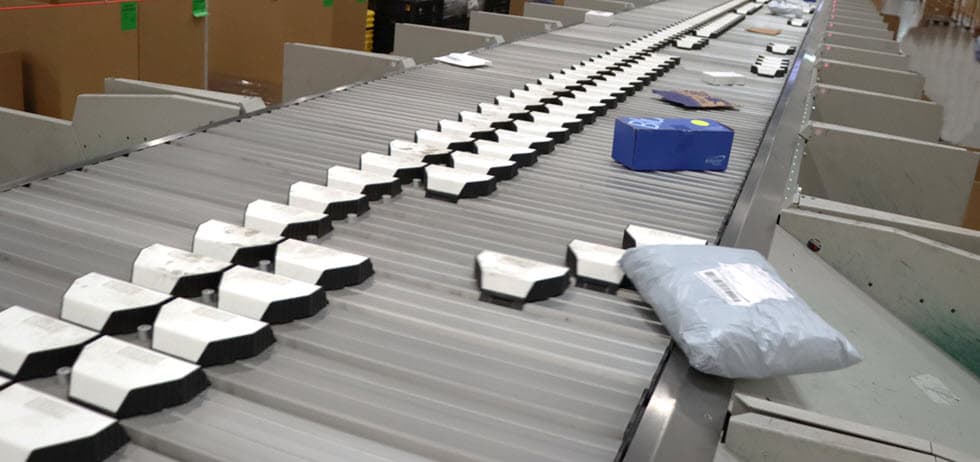
Updated October 2026: A shoe sorter is a high-speed conveyor sorter that uses small sliding “shoes” to push products off the main line and onto the right divert lane. It’s one of the most common ways distribution centers sort poly bags, envelopes, small parcels and boxes to the correct destination without damaging them. A high-speed dual lane shoe sorter takes that idea further by running two sorting lanes in one compact system, so you get more throughput out of less floor space.
Conveyco integrates the 32K high-speed dual lane shoe sorter into new and existing distribution centers. Here’s how the technology works, what it handles well, and what to think about before you add one to your operation.
How Does a Shoe Sorter Work?
The sorter’s conveyor surface is made of slats, with a row of shoes attached along one side and the divert lanes on the opposite side. As a product travels down the line toward its assigned destination, several shoes slide across the slats together and guide it diagonally off the conveyor and onto the divert lane.
That diagonal, multi-shoe motion is the key. Instead of one hard push, the product is eased off the line at an angle, which keeps it moving smoothly and protects it from damage. It’s also why shoe sorters are known as a gentle, accurate option for mixed packages.
What Can a Dual Lane Shoe Sorter Handle?
The 32K dual lane shoe sorter is built for the mix of items most e-commerce, retail and parcel operations see every day, including:
- Poly bags
- Envelopes and jiffy packs
- Small parcels
- Boxes
Chutes can be designed to deliver into gaylords, bins, bags or totes, or directly to autonomous mobile robots (AMRs), so the sorter can feed whatever happens next in your process.
Induction: Getting Product Onto the Sorter
A sorter can only move as fast as product gets onto it. The 32K uses a semi-automated induction system rated at up to 16,000 items per hour per station. Each system can have up to two induction stations, with up to two operators at each one.
The bulk hopper can be fed straight from existing bulk lines, with mechanical upenders or with tilters. The number of induction stations and where they sit are flexible, so the layout can be planned around your application and your building instead of the other way around.
Why a Dual Lane Design Saves Space
Floor space is often the real limit in a growing DC. The dual lane shoe sorter combines high speed, two conveyor lanes, built-in induction and a high-density chute angle in one footprint. Together, those features let you fit more sort destinations and more throughput into less space than many other sortation systems need.
Built for Fast Deployment and Future Changes
The sorter is modular and made in the USA. It arrives in factory-built sections with pre-wired controls, so assembly, installation and service move faster than with a traditional build. That shortens the time your operation is disrupted during installation.
The same modular design pays off later. As volumes, order profiles or your building change, the system can be expanded, modified or even relocated without starting over.
Is a Shoe Sorter the Right Fit for Your Operation?
A shoe sorter is a strong choice when you need to sort a high volume of mixed packages, from bags and envelopes to boxes, to a set of destinations quickly and gently. It’s a common fit for e-commerce fulfillment, retail distribution, parcel and outbound shipping sortation.
It isn’t the answer for every operation. Depending on your items, rates and how orders need to come together, a narrow belt, tilt tray, pocket or robotic sorter may make more sense. The right choice comes from your data, not a spec sheet. Compare the options in our full guide to sortation systems.
What to Plan for When Integrating a Shoe Sorter
The sorter itself is only part of the project. To get the results you’re paying for, plan for how it connects to everything around it:
- Software. The sorter needs to know where every item goes. A warehouse execution system (WES) like New Dawn directs the sorter in real time and connects it to your WMS.
- Upstream flow. Induction rates only matter if product reaches the sorter steadily. Plan the conveyor, bulk feed and staffing that keep it supplied.
- Downstream destinations. Chutes, totes, gaylords or AMRs each change labor, space and handling after the sort.
- Room to grow. Plan the layout with your next few years of volume in mind, not just today’s.
How Conveyco Integrates Shoe Sorters
Conveyco is a warehouse automation systems integrator, not an equipment manufacturer. That means we recommend the sorter that fits your operation and partner with proven manufacturers to deliver it. Using our RightFIT approach, we start with your order profile, volumes and building, design the full system around them, and connect the equipment to your WMS through New Dawn WES. After go-live, our team stays involved to keep the system running and help it grow with you.
Shoe Sorter FAQs
What is a shoe sorter?
A shoe sorter is a conveyor-based sorting system that uses sliding shoes to push products diagonally off the main line and onto divert lanes, sending each item to its correct destination.
What is the difference between a single lane and a dual lane shoe sorter?
A dual lane shoe sorter runs two sorting lanes within one system. That increases throughput and the number of destinations you can serve in a compact footprint, compared with running a single lane.
What items can a shoe sorter handle?
The 32K dual lane shoe sorter handles poly bags, envelopes, jiffy packs, small parcels and boxes, which covers most e-commerce and parcel shipments.
How fast is a dual lane shoe sorter?
The 32K’s semi-automated induction is rated at up to 16,000 items per hour per station, with up to two induction stations per system. Actual throughput depends on your item mix, induction staffing and system design.
Does Conveyco manufacture shoe sorters?
No. Conveyco is a systems integrator. We design the full system, select and integrate sortation equipment from trusted manufacturing partners, and connect it to your software with New Dawn WES.
Can a shoe sorter be added to an existing warehouse?
Yes. Because the sorter is modular and arrives in pre-wired, factory-built sections, it can be installed in existing distribution centers with less disruption, and expanded or relocated later.
Thinking about adding sortation to your operation? Talk to our team about whether a shoe sorter or another sortation system is the right fit.
